
Article: Furnishing a Small Balcony: How to Fit Everything in 3–6 m²

Furnishing a Small Balcony: How to Fit Everything in 3–6 m²
Most small balconies sit empty, or become storage space for a drying rack and an old bicycle. Not because they are unusable — but because they are difficult to furnish well, and anyone who has had one bad purchase usually gives up.
And yet, a 3–6-square-meter balcony can surprisingly quickly become a place where you actually sit every morning. The key is not the furniture, but the order: measure first, then decide on the function, and only choose the furniture at the very end. If you reverse this order — as most people do — you will buy pieces that do not fit.
Step 1: measure and draw the layout
Don’t guess. Measure it and write it down:
- Width and depth in centimeters.
- The direction the door opens — outward or inward? If it opens outward, nothing can be in the door’s swing.
- The railing’s height and type — solid, glass, or metal bars? You can hang things on a railing with bars, but not on a solid one.
- Orientation. A south-facing balcony needs shade, while a north-facing one needs light colors and as little solid furniture as possible.
The only number you need to remember: you need a 60 cm-wide clear path from the door to the railing for movement. If you fill it with furniture, the balcony will be uncomfortable and you will not use it. You can work with whatever space remains.
Typical balcony layouts
| Type | Typical dimensions | What fits |
|---|---|---|
| French balcony | Approx. 100 × 40 cm | Plants, a tray that can be hung on the railing. No seating. |
| Narrow, long | Approx. 300 × 100 cm | Two chairs and one small table in a row along the wall |
| Square, small | Approx. 200 × 200 cm | Two armchairs and a small table, or a three-piece set |
| Square, spacious | Approx. 250 × 250 cm | Dining set for four or a lounge corner |
Step 2: decide what you will use it for
This is the step most people skip. A small balcony works well for one function, but not two. Choose:
- Morning coffee. One chair and a small table. This is the most space-efficient option, and the one most people actually use.
- Sitting together. Two chairs with a small table between them — or two armchairs facing each other.
- Dining. You need a table that can hold plates, plus enough room to pull out the chairs. It takes up more space than you might think.
- Sunbathing, reading. A deep armchair or a reclining sun lounger. You need at least 200 cm of clear space for this.
If you can't decide, choose the morning coffee setup. If that works, you can always add more later.
Step 3: choosing furniture — what to look for
Size comes first
For a small balcony, don't buy deep furniture. A 70 cm-deep armchair on a 100 cm-deep balcony will take up all the space. Look for:
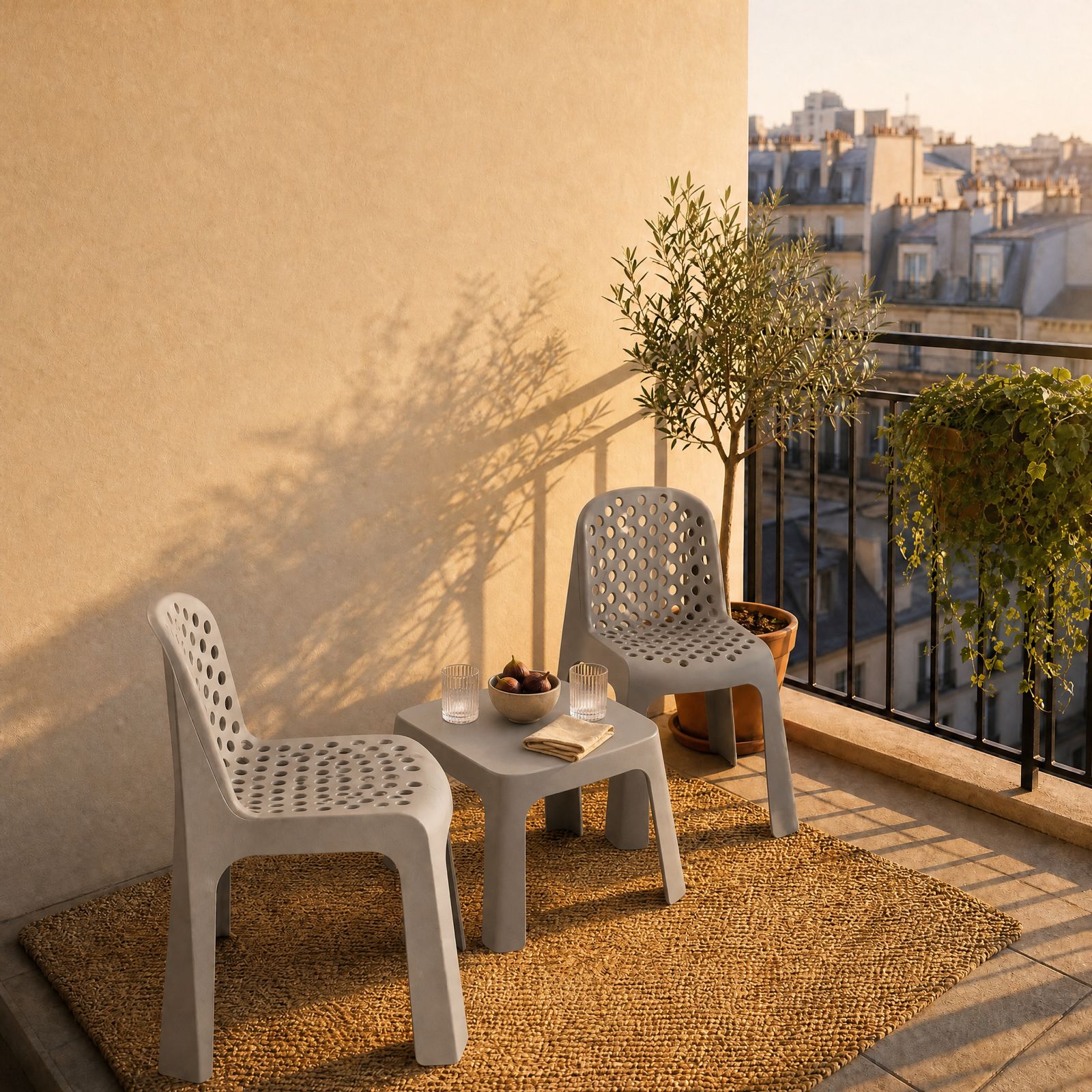
- Chair: maximum depth of 55–60 cm. The Mia & Mimi chair, for example, is 60 cm deep and 54 cm wide — this size still works well.
- Armchair: if you want a piece with armrests, such as the Alme armchair, bear in mind that the armrests add 10–15 cm to the width.
- Small table: A diameter of 40–55 cm is more than enough for two cups. The Mia small table and the Zampa small table fall into this category and can also be used as stools.
Weight comes second
On a small balcony, you move something every day: for cleaning, drying laundry, or bringing things inside when it rains. Choose lightweight pieces that can be moved with one hand. PP plastic furniture is clearly better than aluminum here — it's lighter, many models can be stacked, and they can easily be brought indoors in winter.
One practical consideration: if there's a three-piece set in the right size for you, it's usually a better buy than choosing pieces separately. The Mia & Mimi 3-piece set, for example, has exactly the right configuration — two chairs and a table — for a small square balcony.
Color comes third
In a small space, light, neutral base colors make the area feel more open, while dark furniture makes it feel smaller. But that doesn't mean everything has to be white: one light-colored piece of furniture and one bold-colored textile are the best combination. The cushions and blankets bring in the color, and you can change them every year.
Step 4: make use of vertical space
This is the greatest untapped resource of small balconies. Anything you can't place on the floor, put on the wall or railing:
- Rail-mounted flower boxes — they take up no floor space and conceal the railing.
- Rail-mounted tabletop — foldable, with just enough room for a laptop or two cups.
- Ladder shelf. A decorative ladder leaning against the wall can serve as a plant stand, towel rack, and shelf all in one, taking up minimal floor space.
- Wall-mounted planters and hanging flower holders.
- Wall hooks for folding chairs—hang them up when you're not using them.
Important: always check the weight limits for items hung on the railing, and review your condominium's house rules as well—many places regulate what may protrude beyond the outside of the balcony.
Step 5: textiles and atmosphere
Furniture provides the structure, but textiles make a balcony livable. Four layers worth planning for:
- Outdoor rug. A small, washable one immediately turns concrete into a “room.”
- Seat cushion. For a hard chair, this isn't a luxury—it's the difference between sitting there for twenty minutes or not at all.
- Decorative cushions. Two are enough for a small balcony; more will make it feel crowded. In our decorative cushion collection, you'll find pairs in several sizes and colors.
- A blanket. This makes the balcony usable from September to May as well, not just in summer.
And one small touch that makes a big difference: a scented candle or reed diffuser, plus proper glasses. If the balcony is well equipped, you'll go outside more often.
6. Shade and lighting
Shade: on south- and west-facing balconies, the heat makes them unusable on summer afternoons. Solutions by space requirements:
- Railing-mounted awning or shade sail — no floor space
- Wall-mounted retractable awning — no floor space, but it requires drilling
- Semicircular, railing-mounted umbrella — takes up little space
- Freestanding patio umbrella — only for larger balconies, as the base takes up a lot of space
Lighting: don't rely on the ceiling light. String lights along the railing, plus one or two rechargeable table lamps or candle holders, create a much better atmosphere—and you don't need an electrician.
Three ready-made arrangements
The minimalist — approx. 3 m², for one person
One armchair, one small table, one seat cushion, and a flower box that can be hung on the railing. Morning coffee, evening reading. The smallest investment, the greatest use.
A pair for two — approx. 4–5 m²
Two chairs facing each other, a small table in the middle, an outdoor rug, two decorative cushions, and string lights. This is the arrangement that works most often. Browse the outdoor chairs and outdoor side tables categories to put together your selection.
A lounge — approx. 6 m²
Two deep outdoor armchairs, a coffee table, a rug, a blanket, and shade. Now you can genuinely sit here for two hours.
Three mistakes that leave small balconies unused
- Furniture that is too large. It looked good in the picture but does not fit at home. That is why you need to measure first.
- Too many functions. Dining, sunbathing, and gardening in four square meters: none of them will work well.
- No shade. Even the most beautifully furnished south-facing balcony is unusable in July if the afternoon sun is beating down. Shade is not an extra—it is essential.
Before you buy
Use masking tape to mark the footprint of the furniture you are considering on the floor. Five minutes of work will immediately show you whether everything fits, whether the 60 cm passage remains clear, and whether the door opens.
If you would like to see the sizes in person, our complete outdoor collection is available to view at our showroom in Szigethalom—you can even sit in the furniture before you decide.
Frequently asked questions
What size furniture fits on a small balcony?
Leave a 60 cm-wide clear passage from the door, and work with the remaining space. For a balcony 100 cm deep, chairs that are typically 55–60 cm deep and small tables 40–55 cm in diameter are suitable. A 200 × 200 cm balcony can accommodate a three-piece set.
What type of furniture is suitable for a balcony: plastic or aluminum?
For a small balcony, plastic (PP) is generally the better choice because it is lightweight, many models can be stacked, it can be moved with one hand, and it is easy to bring indoors for the winter. Aluminum furniture is heavier and is better suited to larger, permanent terraces.
How can I create shade on a balcony without a parasol?
Use a railing-mounted awning or shade sail, or a wall-mounted retractable awning. Both take up no floor space, unlike a freestanding parasol, whose base takes up considerable room.
What should I put on a very narrow balcony?
Arrange everything in a row along the wall: two chairs side by side with a narrow side table between them, or a foldable tabletop that can be hung on the railing. Move storage and plants onto the vertical plane—walls, railings, or a ladder shelf.
Can furniture stay on the balcony in winter?
Quality UV-stabilized plastic furniture can stay outside if you clean it, dry it, and cover it with a breathable tarp. However, always bring the cushions and textiles indoors. On a small balcony, the simplest solution is to store lightweight furniture away for the winter.